


To manage make-up classes in an academy without chains of messages, write the rules once (notice period, make-up limit, allowed groups and deadline) and let students book only in the slots that meet those rules. Admin goes from negotiating every make-up class to reviewing only the exceptions.
Managing make-up classes means deciding which student can make up a class, when, with which teacher and in which group. The problem appears when each make-up class depends on loose messages between student, admin and teacher: the make-up class itself is simple, what takes time is the ping-pong around it.
This is how a make-up class gets coordinated on WhatsApp
Here is a normal make-up class handled on WhatsApp:
Student 1: I can't come today. Can I make it up another day?
Admin: Sure, I'll check the slots and get back to you.
Now admin has to check the calendar, group, teacher and capacity.
Admin -> Teacher: Do you have room for one more student on Tuesday at 6 pm?
Student 2: I also have a class to make up. Is there a slot this week?
Same problem, but with another person competing for the same times.
Teacher: I could do Tuesday from 6 to 7 pm, but don't confirm yet. I might have to move a class first.
Admin -> Student 1: We have Tuesday at 6 pm. Does that work for you?
Student 1: I'll let you know later.
Student 2: Tuesday works for me.
Now the slot is unclear: one person asked first, another confirmed first and the teacher is still waiting for a final answer.
Student 1: Actually, I can make Tuesday.
Admin: Hold on, let me check again.
That is eleven messages and the make-up class is still not settled. It is still unclear whether both fit, whether the group can take another student, whether the teacher is still available, whether the class counts as a make-up and whether anyone else had asked for that slot. In an academy with flexible make-up classes, this conversation repeats every week.

Why do academies offer more and more make-up classes?
Because families and students expect to be able to change a class when there is an exam, an illness, a trip or a shift change, and flexibility helps prevent withdrawals. What changes in each type of center is what the slot depends on:
- in a language academy, the group's level;
- in a tutoring center, the subject and the available teacher;
- in a music school or dance school, the room, instrument, level or choreography;
- in a sports center, class packs, capacity and the coach;
- in a padel and tennis school, the level and free places in each class;
- in an art academy, the workshop, materials and capacity.
Being flexible without a system turns every make-up class into a negotiation.
Why don't WhatsApp and Excel solve make-up classes?
Because WhatsApp is for talking and Excel for writing data down, but neither applies rules. A make-up class needs to cross-check at once who was absent, whether they gave notice in time, which teacher can take them, which group has room and who confirmed first.
When that is handled with messages and spreadsheets, admin becomes the switchboard, and the same problems always appear:
- slots offered to two people at once;
- students waiting for confirmation;
- teachers interrupted during their classes;
- forgotten make-up classes;
- old chats that have to be reread to reconstruct what happened.
A tidier Excel sheet does not fix it. If you are at that point, look at these alternatives to Excel for academies, and if you first need to set the rule, use the make-up class policy and tracking template.
Which make-up class rules should you set?
It needs six decisions made before anyone looks for a slot:
| Decision | Why it matters |
|---|---|
| Notice in time or late notice | An absence reported 24 hours ahead should not be treated like one without notice. |
| Limited or unlimited make-up classes | Without a limit, accumulated make-up classes can fill the calendar. |
| Original or compatible teacher | Sometimes the teacher matters; other times, only the level. |
| Own group or equivalent group | Avoids putting students in classes that do not fit. |
| Free places in the class | A make-up class should not exceed capacity. |
| Visible history | Admin, teacher and student must see what was decided. |
These rules have to live in the system, not in admin's head.
What changes when make-up classes are managed with a system?
Who does each step changes. With rules configured, the student and the system do most of the work admin used to do:
| Moment | Manual management | Management with a system |
|---|---|---|
| The student says they cannot attend | WhatsApp message and manual search | The student cancels in the app and the absence is recorded |
| Options are found | Admin checks calendar, teachers and groups separately | The student only sees the slots that meet your rules |
| The teacher finds out | Individual message | The teacher sees the class with its students up to date |
| The student chooses a slot | Another pending conversation | The make-up class is booked in that class |
| Someone asks what happened | Chats have to be reviewed | The history is in the student's record |
How does Clasbi manage make-up classes?
Clasbi is management software for academies and sports centers that brings schedules, attendance, make-up classes, communications and payments together in one place. For make-up classes it works like this:
- the student cancels in the app with the notice you set, without calling or writing;
- their class balance is adjusted and the place is freed immediately;
- another student can book that slot, only in the groups you allow for them;
- teacher and student receive the corresponding notification;
- the academy decides which absences can be made up and until when.
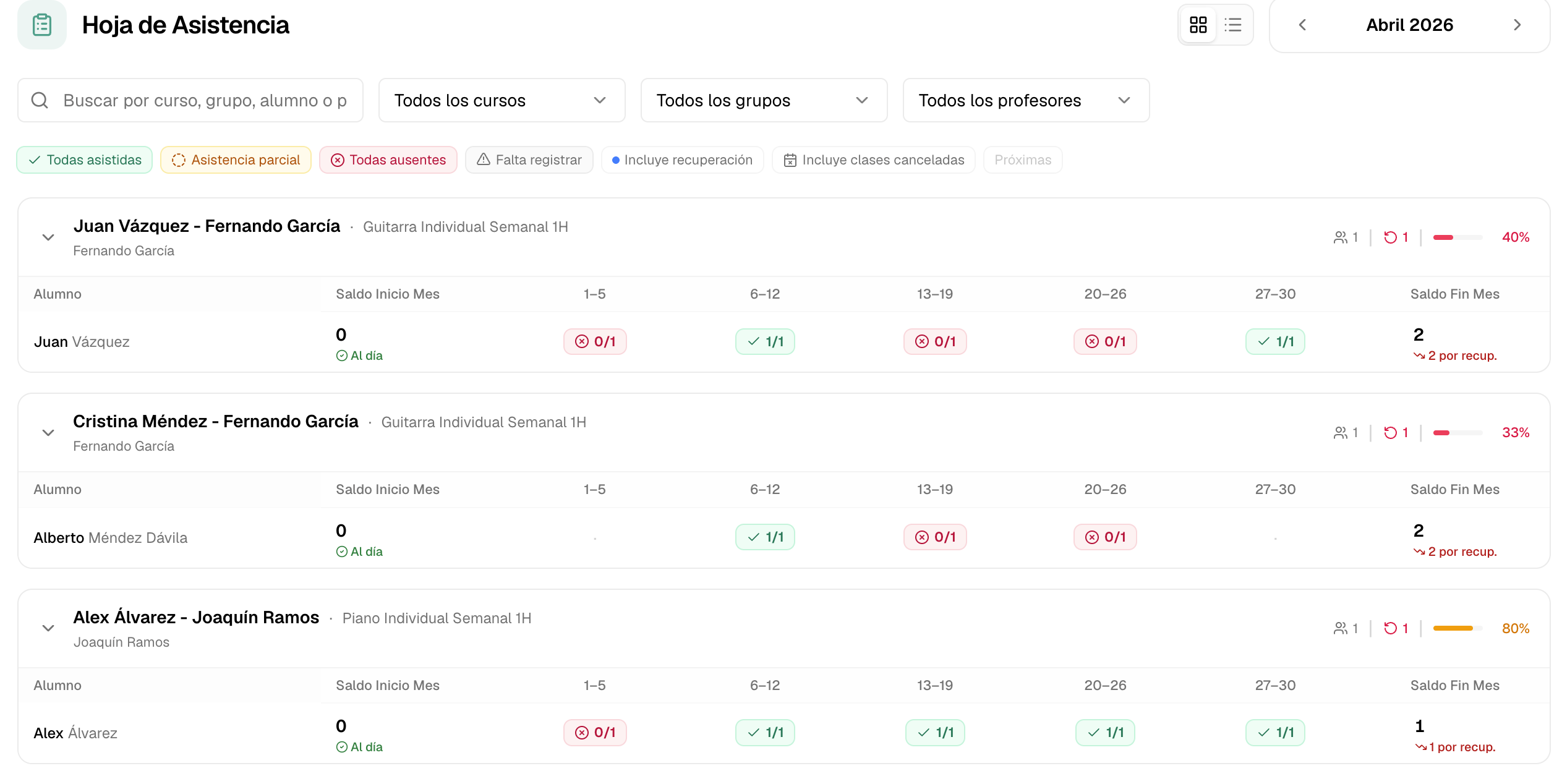
Admin only steps in for cases that need judgment, such as an exception for a long illness.
Is it worth offering make-up classes?
Yes, if they are managed with rules. Make-up classes give families flexibility and help prevent withdrawals, but they only pay off if they do not turn admin into a switchboard. The answer is managing flexibility better, not offering less of it.
To see the full flow with screenshots, visit the make-up classes in Clasbi page.