

To write a make-up class policy for an academy, decide six things and put them in writing: how much notice is needed (usually 24 hours), how many make-up classes can be accumulated (1 or 2), until when they can be used, in which groups, where they are recorded and how they affect the monthly fee. Then keep a record of attendance, make-up classes and balances that the whole team can check.
The policy prevents improvised decisions; the tracking sheet keeps you from losing track of each pending class. Rules make sure flexibility does not depend on one person's memory or loose conversations.
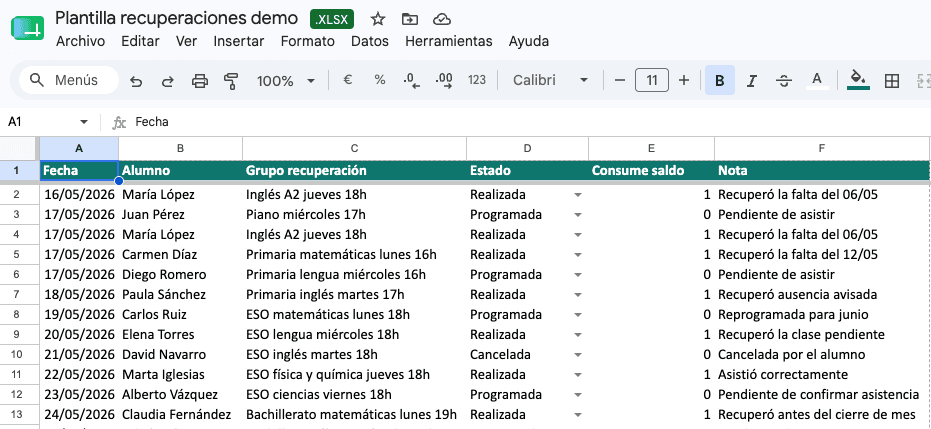
This article includes two free templates prepared by the Clasbi team: a base policy to adapt and a tracking sheet to record attendance, completed make-up classes, pending classes and calculated balances.
What problem does a make-up class policy solve?
It stops each make-up class from being decided differently depending on who asks. Without a written policy, one student gives 2 hours' notice, another 24, another asks to make up a class from three months ago and another family asks for a discount, and each case is resolved its own way.
That creates three risks:
- families who do not understand why some people are allowed more than others;
- teachers who end up negotiating schedules instead of teaching;
- pending classes nobody knows are still valid, expired or already made up.
What should you decide before writing the policy?
Six things: the notice period, the limit on pending classes, expiry, compatible groups, where it is recorded and how it affects the monthly fee.
| Decision | Practical recommendation |
|---|---|
| Notice period | Choose 12, 24 or 48 hours and apply it equally to everyone. |
| Accumulation limit | Allow 1 or 2 pending classes at a time. |
| Expiry | Set a visible deadline for using the make-up class. |
| Compatible groups | Make up only in classes that fit by level, age, format and capacity. |
| Record | Keep attendance, absences, balances and make-up classes somewhere the team can check. |
| Monthly fee | Clarify whether the absence is deducted or whether the make-up class is part of the fee. |
1. How much notice should be given for an absence?
Usually between 12 and 48 hours, and 24 hours is the most balanced starting point: it lets you accept genuine absences without turning every missed class into a last-minute reorganization.
What matters is that the rule is stable. If one family gets 12 hours and another 24 because they insist more, the rule stops protecting the academy.
2. How many make-up classes can a student accumulate?
The most reasonable option is to allow 1 or 2 pending make-up classes at a time. A policy with no limit seems kind at first, but when a student accumulates 6, 8 or 10 pending classes, the academy is no longer managing make-up classes: it is trying to fit in a promise that is hard to keep.
When the student reaches the limit, no new make-up classes are generated until they use one of the previous ones.
3. Until when can a class be made up?
Until the deadline set in the policy: within the same month, the term or a specific number of weeks. The deadline must be in writing, because a make-up class without an expiry ends up in one of two places: forgotten or disputed.
The exact deadline depends on the academy's calendar, but it must be easy to understand and apply. If the answer is "whenever we can", it is not a policy yet.
4. In which groups can a class be made up?
In groups compatible by level, age, format, teacher and capacity: not every free slot is a valid slot. Compatibility matters more than the slot, especially in music and tutoring, where a free chair is not enough: the instrument, subject, year or class goal also has to fit.
In a language academy, a make-up class may depend on the level; in a tutoring center, on the subject; and in a music school, on the instrument or the teacher. In a sports center or a padel and tennis school, it usually depends on capacity and group level; in an art academy, on the workshop and materials.
The usual criteria for accepting a make-up class are:
- same or equivalent level;
- compatible age;
- compatible format: one-to-one, pair or group;
- original teacher or a teacher qualified for that content;
- free places without lowering the group's quality.
5. Where are absences and make-up classes recorded?
In a shared record that meets three conditions: anyone on the team can check it, it does not depend on searching old messages and families can see how many classes they have pending without asking every week.
At a minimum, the academy needs to see who was absent, whether they gave notice in time, whether it created a right to a make-up class, when it expires, where it was made up and whether it already used up balance.
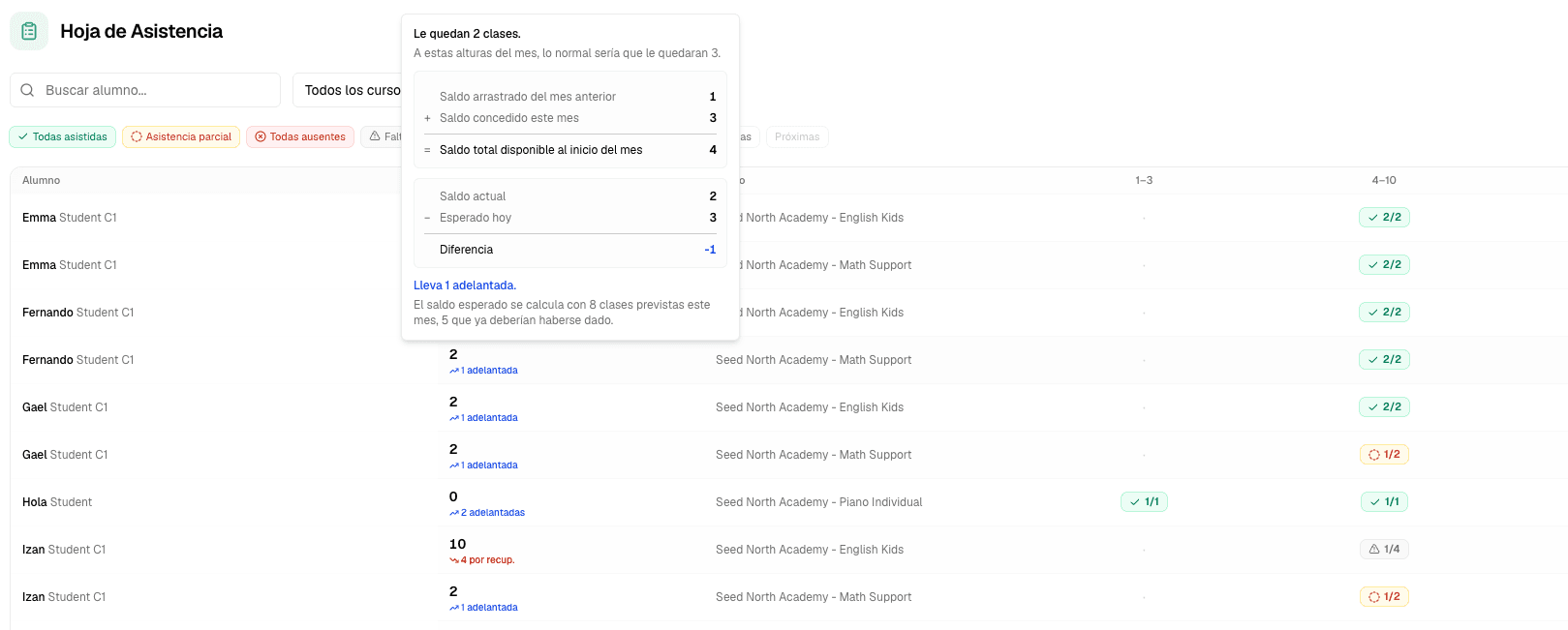
Clasbi is management software for academies and sports centers that brings schedules, attendance, make-up classes, communications and payments together in one place. In Clasbi, students cancel in the app with the notice you set, their balance is adjusted and they can only make up classes in the groups you allow; you can see it on the make-up classes page.
If the main problem is the constant back-and-forth of messages, also read the guide on how to manage make-up classes without depending on WhatsApp.
6. Are missed classes deducted from the monthly fee?
Usually not: the place is still reserved, the teacher is still scheduled and the academy's fixed costs keep running. What is offered in exchange for notice is the chance to make up the class when there is a compatible slot. The monthly fee must be clear before the absence, because this point causes many complaints if it is not in writing.
Some academies prorate, use class packs or apply discounts in specific cases. Any model can work if it is explained in advance. It helps to separate normal absences from special cases: long sick leave, an agreed formal pause, a long trip, a family emergency or a class cancelled by the academy itself.
Template 1: make-up class policy for families
You can use this base as a starting point for the visible part of your policy. Adapt the brackets to your academy before publishing it.
At our academy we try to support regular attendance and, when possible, offer make-up options. To keep the organization fair for all students and sustainable for the team, we apply the following conditions:
- Absences must be reported at least [X hours] in advance to be eligible for a make-up class.
- Classes missed without notice within the set deadline are not eligible for a make-up class, except for justified reasons or exceptional cases assessed by the center.
- Make-up classes are subject to availability in groups compatible by level, age, format, teacher and capacity.
- Pending classes can be made up within a maximum of [X] from the absence.
- Each student can accumulate a maximum of [X pending classes].
- Missed classes are not automatically deducted from the monthly fee, unless the center has agreed a specific policy.
- All absences, make-up classes and changes are recorded so that admin, teachers and family have the same information.
- Medical, family or force majeure situations may be reviewed individually by the center.
Which cases should you review before publishing the policy?
Before sending the make-up class policy to families, answer these five cases in writing:
- A student gives 2 hours' notice because they have a fever.
- A family asks to make up a class from two months ago.
- A teacher said there was a slot, but the group is already full.
- A family asks for a discount because their daughter missed three classes.
- A student wants to make up a class in a different-level group because it suits them better.
If any answer starts with "it depends", make the rule more specific. A good policy reduces conversations; if it forces you to explain every case from scratch, it is still too open.
How do you communicate the policy to families?
First to the team and then to families, in advance and explaining the reason. If a family calls and each teacher gives a different answer, the policy is broken from day one.
It is not the same to say:
From now on, classes outside the deadline will not be made up.
As to say:
We have noticed that some make-up classes get lost in crossed messages. So that all families have the same conditions, we will record absences and make-up classes using a single rule.
The second version conveys order rather than punishment. It is also wise to respect balances already agreed before the change.
Template 2: tracking attendance, make-up classes and balances
It is a tracking sheet that shows how many pending classes each student has. It is useful if you still manage make-up classes with Excel, WhatsApp or loose notes, because it brings everything into a single record.
The tracking template helps you see:
- which student was absent and when;
- whether the absence creates a right to a make-up class;
- how many classes they have pending;
- which make-up class has already been taken;
- what balance remains after each change.
We will email you this template when you fill in the form on this page.