

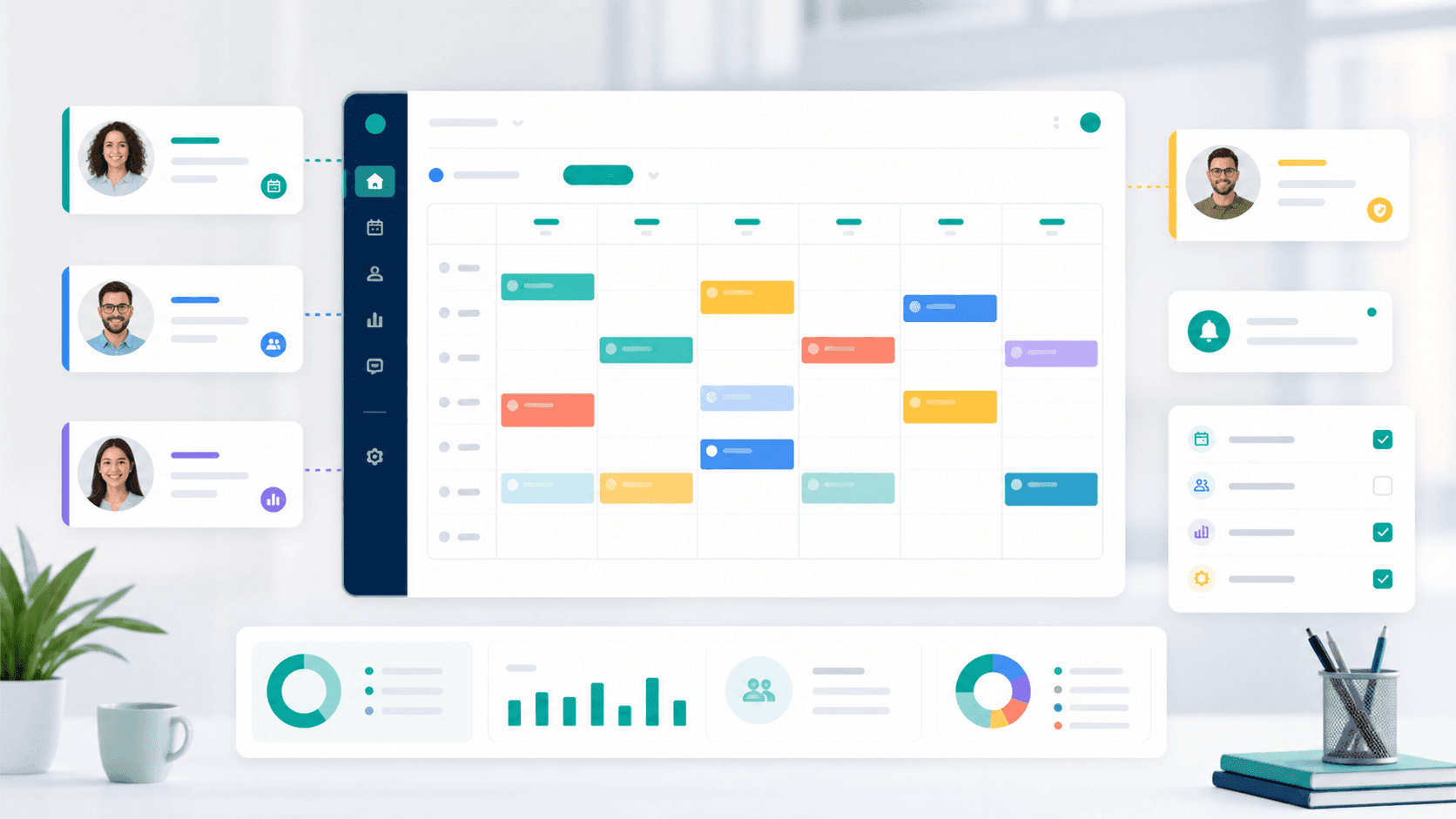
To run an academy with several teachers without depending on management, define what each role can decide, write rules for the decisions that come up every week and use a single system where each teacher checks their schedule and students and records attendance. Management stops answering basic questions and only receives exceptions.
When an academy has a single teacher, many decisions are made informally: the same person knows the schedules, knows which student is absent, remembers which make-up class is pending and tells families when something changes. The problem appears when the center grows and every question ends up with management:
- Which classroom am I in now?
- Which students are in this group?
- Can this class be made up?
- Who covers an absence?
- Has the family been told yet?
- Where do I record attendance?
Management stops managing and starts working as a switchboard. Running an academy with several teachers requires a system where each person handles what is theirs and management steps in when its judgment adds value.
What needs to be defined before delegating to teachers?
Three things: what each role can decide, what information it needs and when a situation must be escalated.
1. What responsibilities does each role have?
Teachers take care of their classes and management takes the decisions that affect several groups or money. A simple split could look like this:
| Area | Teachers | Coordination or management |
|---|---|---|
| Today's classes | Check schedule, group and classroom | Step in if there is a structural change |
| Attendance | Record attendance and notes | Review incidents and patterns |
| One-off changes | Report an incident and suggest an alternative | Approve changes that affect other groups |
| Make-up classes | Apply the rules and point out options | Resolve exceptions and capacity conflicts |
| Class communication | Send notices about their class | Handle general or sensitive communications |
| Payments and conditions | Pass the question on | Keep financial responsibility |
The table does not have to be identical in every academy. What matters is that the team knows what it can resolve without asking permission and which cases need a decision from above.
2. Which frequent decisions should become rules?
The ones that come up every week and today depend on management's memory:
- when an absence allows a class to be made up;
- how much notice the student must give;
- who can cover for a teacher;
- what happens if the group is full;
- how an incident is recorded;
- when a class can be moved;
- what information is shared with the family and through which channel.
If a decision comes up every week, it needs a rule, not another conversation. This matters especially for make-up classes, because they mix attendance, availability, teachers, groups and communication.
3. What information should each teacher see?
Each teacher should see what they need to teach their classes and record what happens in them, not all of the academy's information. Management keeps the view of the whole center, the rule settings, the financial information and the decisions that affect several groups.
Well-defined access avoids two problems at once: teachers having to ask for basic data all the time, and anyone being able to change information that is not theirs. Autonomy works best when access is broad within the role and limited outside it.
Why is it important to have a single version of the schedule?
Because with several teachers the biggest risk is that each person works from a different schedule. A schedule in Excel, another in Google Calendar, a note on the director's phone and several messages with pending changes create a chain of doubts:
- One teacher receives a change.
- Another is still looking at the old schedule.
- The family asks which time is correct.
- Management has to reconstruct what was communicated and when.
The solution is for classes, groups, teachers, students and changes to live in one system.
If this is what takes up most of your time, also see the guide to schedule and calendar management in academies.
What should reach management, and what should not?
Management should receive exceptions that need judgment, not questions that can be answered by looking something up. Compare these two messages:
"What time is my class tomorrow?"
"Tomorrow two students are missing from the Tuesday group. If you agree, I can merge it with the 6 pm group."
The first needs access to information; the second needs judgment. To decide with data, management should review every week:
- classes taught and pending closure;
- unrecorded attendance;
- open incidents;
- pending make-up classes;
- teacher or classroom changes;
- groups with low attendance;
- payments or balances that need follow-up.
With that information, management answers fewer loose messages and spots in time a group that is losing students or an overloaded teacher.
How does management software help when there are several teachers?
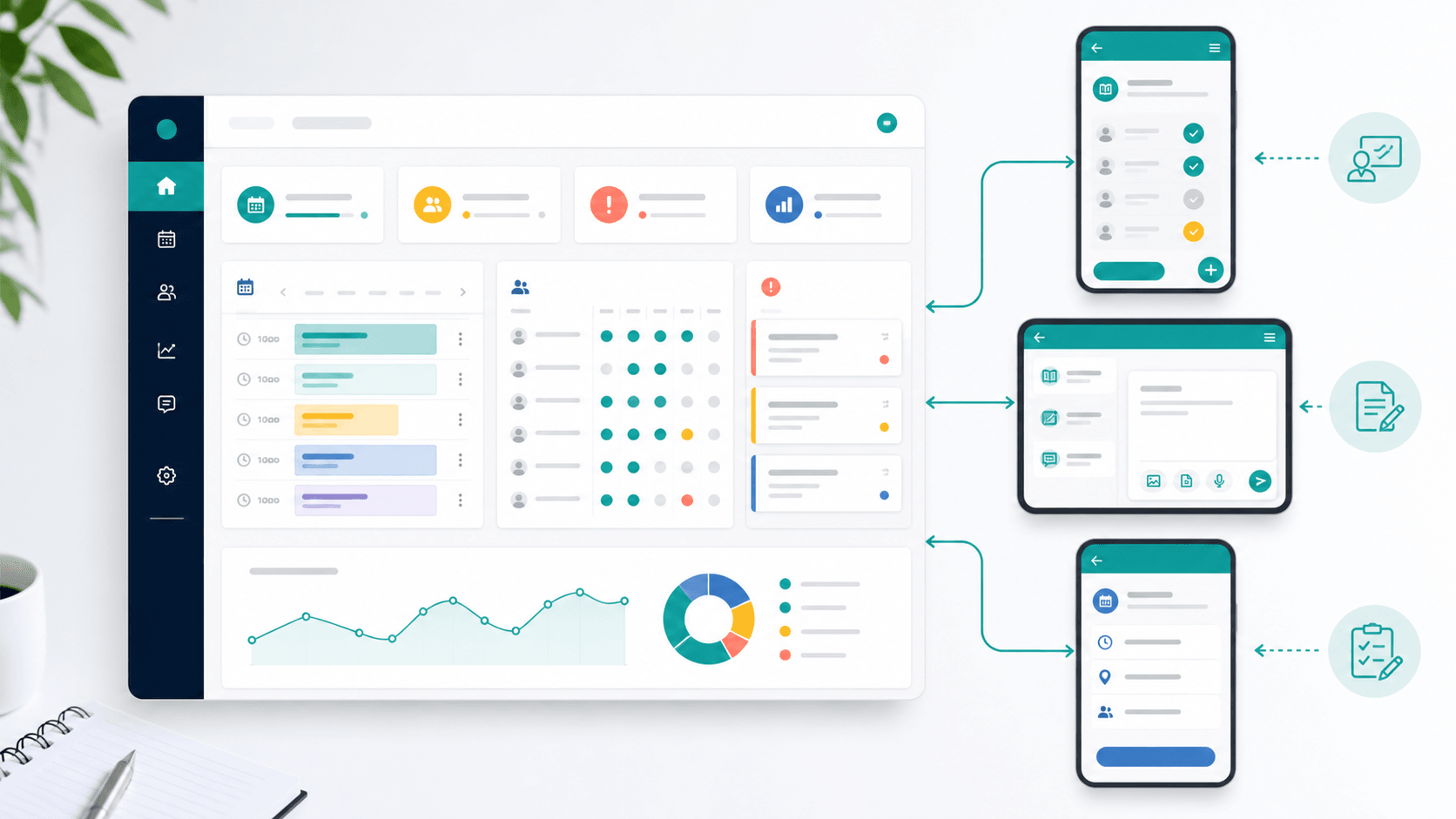
Management software separates the tasks the team handles on its own from the decisions that need management. Clasbi is management software for academies and sports centers that brings schedules, attendance, make-up classes, communications and payments together in one place.
With several teachers, Clasbi works like this:
- each teacher has a portal with their classes, students and attendance;
- classroom, teacher or time changes show up immediately in their agenda;
- each teacher clocks their hours from their phone;
- make-up classes follow the rules set by management;
- management sees payments, attendance and schedules for the whole center from their account.
To compare options, see the guide to the best academy management software, and to organize the team's working hours, the guide on teacher time tracking in academies.
How do you know if your academy depends too much on management?
Answer these ten questions:
- Can each teacher check their up-to-date schedule?
- Can they see the students and the information they need about their groups?
- Do they record attendance on the spot through a simple process?
- Are there written rules for absences, make-up classes and changes?
- Is it clear which incidents each role can resolve?
- Is there a single place to check classes, groups and schedules?
- Does management receive exceptions with context instead of repeated questions?
- Does access protect financial information and sensitive decisions?
- Can you see how the academy is doing without chasing messages?
- Does the academy keep running when management is unavailable for a few hours?
If three or more answers are "no", the academy does not need more supervision: it needs written rules, access to information and a shared system.
Can an academy run without management controlling everything?
Yes, if the rules and information are in a shared system. Management sets the rules, protects the quality of the service and takes the important decisions; teachers work autonomously in their classes and report exceptions with context.
The key is to replace constant control with shared information that anyone can check. Try Clasbi for free and see how your academy can work with several teachers without all the information going through management.