

Yes. Since May 2019, every academy in Spain with employed teachers must record each teacher's start and end time every day, keep that record for four years and make it available to the Labor Inspectorate. Not doing so is a serious infringement, with fines of €751 to €7,500.
When there is an inspection, a claim for hours or a question about a teacher's actual working day, saying "we have it in Excel" is not enough: you must be able to prove that the record exists, is daily, shows start and end times, is kept and could not be manipulated afterwards.
That is why Excel falls short as a time record. The law does not ban any specific tool, but a normal spreadsheet can be edited, duplicated, lost, filled in late, mixed with other versions or stored on one person's computer. That fits poorly with what the Spanish Ministry of Labor describes as reliable, unmodifiable, non-manipulable and traceable information.
For an academy with several teachers, split shifts, substitutions, online classes, several locations or last-minute changes, time tracking has to be something each teacher does in seconds from their phone. If clocking in is difficult, the record ends up being rebuilt afterwards, and a rebuilt record is exactly what defends the academy worst.
What does Spanish law require for working-time records?
It requires a daily record of each employee's start and end time, kept for four years. The obligation is in article 34.9 of the Workers' Statute, which requires the company to guarantee a daily record of working hours with each employee's specific start and end times.
Records must be kept for four years and be available to:
- employees;
- their legal representatives;
- the Labor and Social Security Inspectorate.
The obligation was introduced by Royal Decree-law 8/2019, as part of measures against job insecurity in working hours.
The Ministry of Labor also published an official guide on working-time records with two ideas that matter especially for academies:
- the record must make it possible to know the real working day and help the Inspectorate check it;
- any system must provide reliable information that cannot be modified or manipulated afterwards, with traceability and a trustworthy trail once recorded.
The law does not require a specific system, but it makes the result clear: a daily record that works as real proof of the working day.
What are the fines for not keeping time records?
From €751 to €7,500, because not keeping them is a serious infringement. Spain's Law on Social Order Infringements and Penalties (LISOS) treats as serious any breach of legal or agreed rules and limits on working hours, overtime, rest, holidays, leave, time records and working time in general.
Serious infringements are currently fined as follows:
| Degree | Fine |
|---|---|
| Minimum | €751 to €1,500 |
| Medium | €1,501 to €3,750 |
| Maximum | €3,751 to €7,500 |
On top of the fine comes the time spent rebuilding working days, reviewing messages, looking for spreadsheet versions and justifying schedules when there is already a claim on the table. Time records must be ready before you need them.
Can Excel or a paper sheet be used for time tracking?
They can, with risk, because they can be edited without a trace and filled in late. They are common because they look simple: a table with teachers' names, day, start time and end time. But a time record is legal proof as well as a table, and it must hold up if there is an inspection, a claim or a question about hours worked.
In practice, a manual sheet fails on very specific points: it can be edited without a clear trail, it is filled in late, it is stored on one computer or in one filing cabinet, it is not always available when requested and it forces you to rebuild schedules, classes, substitutions or absences by hand.
What you need is a daily record that cannot be changed without leaving a trace and that can be checked at any time.
How do teachers clock in with Clasbi?
Each teacher clocks in and out from their phone, the record is saved and admin can review or export it whenever needed. Clasbi is management software for academies and sports centers that brings schedules, attendance, make-up classes, communications and payments together in one place.
The time record is connected to the rest of the academy:
- Clock in from the phone: teachers do not depend on the front desk or a paper sheet.
- Start and end times saved: the record keeps the exact clock-in and clock-out time.
- Review by admin: the center can spot missed clock-ins, gaps or inconsistencies.
- Exportable data: the information can be extracted whenever it needs to be reviewed or handed over.
- Next to the classes: clocking in happens in the same app where teachers see their classes, schedules and attendance.
- Clock in on the spot: because it is done from the phone on arrival, the working day does not have to be rebuilt later.
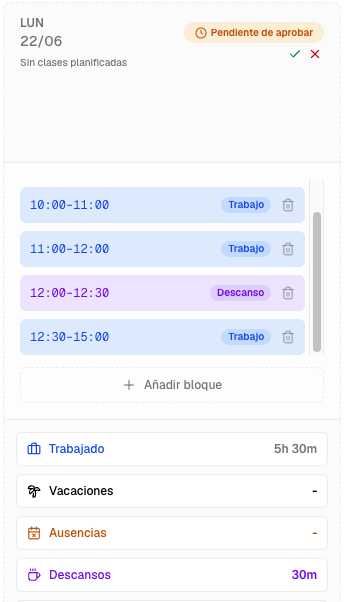
A tool does not replace employment advice: each academy should review its case with its advisor, its collective agreement and its internal agreements. What Clasbi does cover is the daily part that Excel or a paper sheet usually handles badly: clocking in from the phone, saving the record, reviewing it from admin and exporting it when needed.
If you want to see how time tracking would look in your center, tell us how your academy works and we will show you with your real teachers, schedules and rules.
Note: this article is a practical guide, not legal advice. To interpret specific obligations, collective agreements or employment situations, consult your employment advisor.