

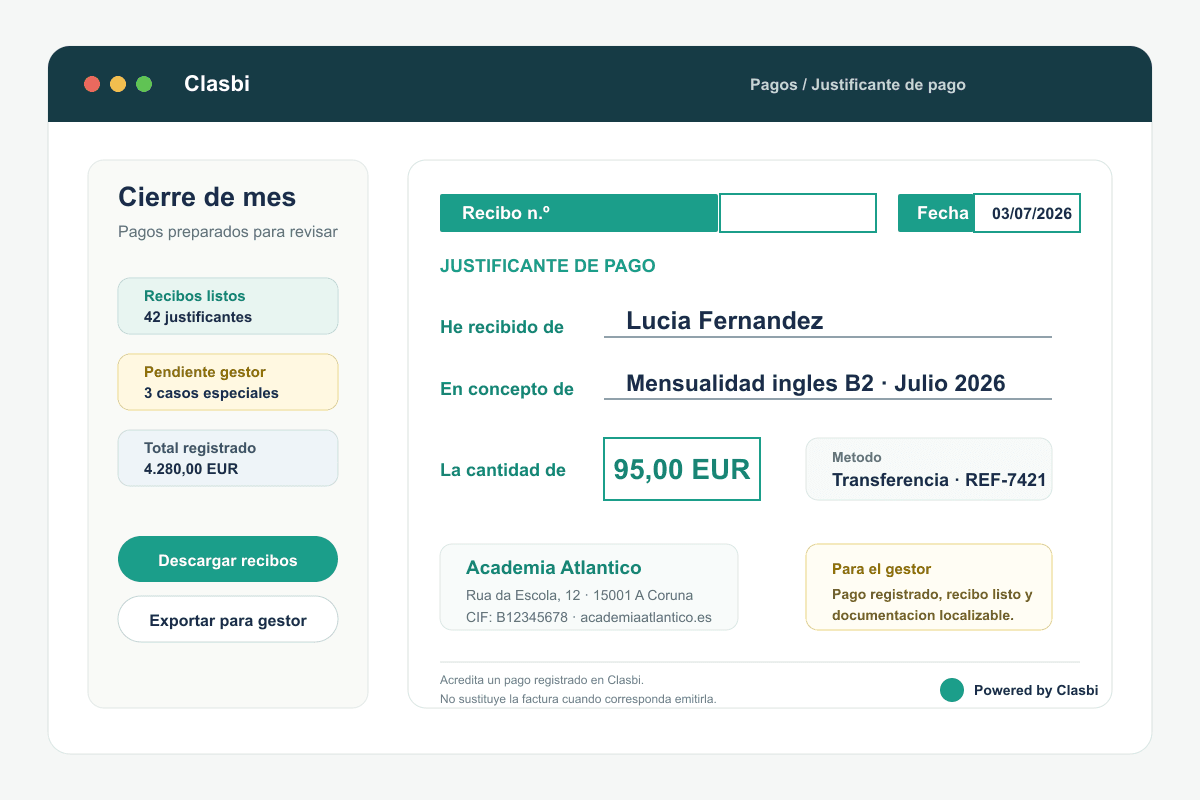
In a Spanish academy whose classes are VAT-exempt, a digital receipt is usually enough as proof of payment for families, and an invoice is mandatory when a business or public administration pays, or when it is requested to exercise a tax right. Verifactu only affects programs that issue invoices, not receipts. To sort it out, start with VAT: once you know which activity is exempt, it is easier to decide whether a digital receipt is enough, whether to issue an invoice and what your accountant needs.
Why are many academy classes VAT-free in Spain?
Because in Spain many educational activities are exempt from VAT. The main reference is article 20.One.9 of Law 37/1992 on VAT, which covers school and university teaching, languages, vocational training and retraining when the applicable requirements are met.
In academy terms: many class fees paid by families are treated as an exempt educational activity, with no VAT added.
That does not make every academy, course and charge exempt. So before thinking about receipt or invoice, the first question is: what service are you charging for, and does it fall within the educational exemption?
This article is a practical guide, not tax advice. To decide the exact VAT and invoicing treatment, review your case with your accountant.
Which activities are VAT-exempt and which are not?
Educational classes are usually exempt; selling materials, renting classrooms and leisure activities usually are not. This table summarizes the common cases:
| Case | Usual treatment the academy should check |
|---|---|
| Educational classes for families, such as languages, tutoring or formal/non-formal training that fits the exemption | May be VAT-exempt |
| Vocational training or retraining that meets the requirements | May be VAT-exempt |
| Sale of books, materials, uniforms or other products | May have a different treatment and not be the same operation as the class |
| Renting a room, classroom or space | May require an invoice and different treatment |
| Leisure workshops, sports services or activities that do not qualify as exempt teaching | May not be exempt |
| Mixed operations, for example course plus materials or class plus room rental | Separate the concepts and check with your accountant |
The practical key is to separate concepts. A monthly fee, an enrollment fee, a class pack, materials sold and a classroom rental should not be recorded as a single "payment". When the concept is clear, so are the receipt, the invoice if needed and the accountant's review.
Is a digital receipt enough to charge for classes?
Yes, for most family payments for exempt educational classes, a digital receipt is usually enough as proof of payment. The receipt shows who paid, which student or family it relates to, what concept was charged, how much, when, by what method and which academy issues it.
This covers many real requests: keeping proof, justifying a monthly fee or sending the document to whoever handles the payment.
The key point: if there is no obligation to issue an invoice, the digital receipt records the payment without turning it into a tax invoice.
When does an academy have to issue an invoice?
When the recipient is a business, a professional or a public administration, when the invoice is requested to exercise a tax right, or when the service is not exempt. In some cases a receipt is not the right document. The Invoicing Regulation, Royal Decree 1619/2012 lists cases where an invoice must always be issued: for example, when the recipient is a business or professional, a public administration or when the invoice is required to exercise a tax right.
The same regulation also includes exceptions to the obligation to issue an invoice for certain operations exempt under article 20 of the VAT Law, except for the cases the regulation itself keeps as mandatory.
In an academy, consider issuing an invoice when:
- a company pays for training for its employees;
- a public administration or legal entity is the recipient;
- a family needs it for tax or legal reasons;
- separated parents ask for more formal or separate documentation;
- you rent out a room or classroom;
- you sell materials or other products;
- the service does not qualify as exempt teaching.
The practical answer is to record every payment properly and issue an invoice when it applies, not for everything "just in case".

What changes with Verifactu?
Verifactu does not automatically turn all of an academy's receipts into invoices. The AEAT explains in its FAQ on invoicing software that the regulation applies to systems used to issue invoices or simplified invoices, not to documents that are not considered invoices.
The legal dates currently in force, from Royal Decree-law 15/2025, are 1 January 2027 for entities that file Corporate Income Tax and 1 July 2027 for everyone else. On 5 October 2026 the Spanish Ministry of Finance announced that it will postpone Verifactu to October 2028 for everyone, but until that change is published in the BOE, the 2027 dates still apply.
For an academy, this comes down to three rules:
- if you issue invoices with software, that software must be adapted when the obligation applies to you;
- if you issue documents that are not invoices, those documents are not Verifactu in themselves;
- if you are unsure between a receipt, an exempt invoice or an invoice with VAT, your accountant should review the case.
Verifactu makes it more important to record payments and concepts properly, because the invoices you do issue will have to come from adapted software.
What does your accountant need each month?
They need to see the whole month, not loose PDFs: income by date, student or payer, concept, payment method, receipts for non-invoiced payments, invoices issued, expenses, invoices received, basic reconciliation and notes on special cases.
With that, the accountant can review income, VAT if applicable, invoicing obligations and bookkeeping without rebuilding the month from conversations and spreadsheets.
What should a good receipt and invoicing system include?
It should generate the receipt from the recorded payment, without redoing it by hand, and keep concepts separate. Generic invoicing software issues documents, but an academy needs them connected to students, groups and fees. A good system should let you:
- record payments from students, families, groups, class packs and enrollments;
- generate digital receipts automatically when a payment is recorded;
- download or send proof of payment without redoing it by hand;
- separate educational concepts, materials, rentals and other services;
- prepare clear information for the accountant;
- issue invoices on demand when needed and connect them to Verifactu when it applies.
That way, receipts, payments, invoices and Verifactu come from the same data the academy already uses every day. The guide to choosing an academy management program covers what to check before signing up.
How does Clasbi handle receipts and payments?
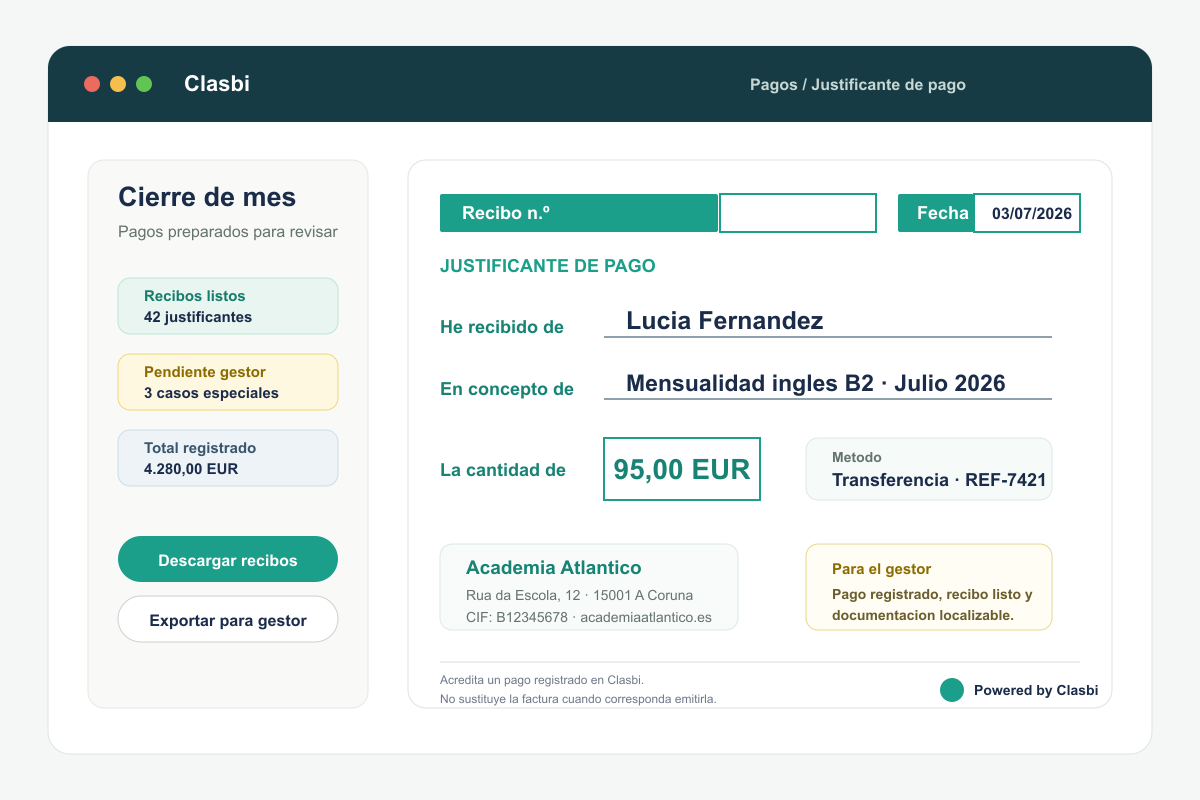
Clasbi is management software for academies and sports centers that brings schedules, attendance, make-up classes, communications and payments together in one place. On the financial side, it records fees, class packs, recurring charges and pending payments per student, and generates digital receipts from each payment.
When you record a payment, you can generate proof of payment with the relevant data without copying information by hand. That document certifies that a payment was recorded in Clasbi. It does not replace an invoice when the academy must issue one.
When a family asks for proof of payment, it is already generated, and the month's data is ready for the accountant. Clasbi's Verifactu integration is in development and appears as "Coming soon" on the website; it will be activated on the same base of payments and concepts.
If you currently close the month by checking Excel, WhatsApp, Bizum and loose receipts, the problem is both tax-related and day-to-day, and management software solves both with the same data.